Land at Sanqiutian before 8:30. Walk the consulate quarter, climb to Bagua Mansion, cut across the island to Shuzhuang Garden, and leave Sunlight Rock and the snack street for after lunch. Sail back from Sanqiutian around 3. About 5 km of walking.
Before you set off
Sort the ferry first. Visitors use the tourist terminal at Dongdu, and tickets for foreign passports usually need collecting at the counter. Our ferry guide has the detail. Leave suitcases at the terminal.
Bring water, which costs several times the mainland price on the island, a hat, and shoes with grip. Recent visitors are unanimous on the last point. The lanes are polished stone.
The island's own maps are posted at every junction and phone signal is fine. You will not get lost for long.
The route
8:30 — Sanqiutian pier and the consulate quarter
You step off into the oldest part of the foreign settlement. Gulangyu was opened to foreign residents after Xiamen became a treaty port, and formally became an international settlement in the early 1900s, run by its own municipal council. Thirteen countries eventually kept consulates here.
Walk along the waterfront to Lujiao Road. The former British Consulate, at number 16, now houses an exhibition on the island's history, and it is worth twenty minutes because it explains everything you are about to see. The former Japanese Consulate, a red-brick building from the late 1890s, is at number 26. The former American Consulate stands on the waterfront near Sanqiutian.
At this hour the streets still belong to residents.
9:30 — The “corner” and Bagua Mansion
Walk uphill on Guxin Road. You will pass a wedge-shaped red-brick house at a fork in the lane with a queue of people photographing each other in front of it. Chinese social media calls it the most beautiful corner on the island. It is a nice house. Keep walking.
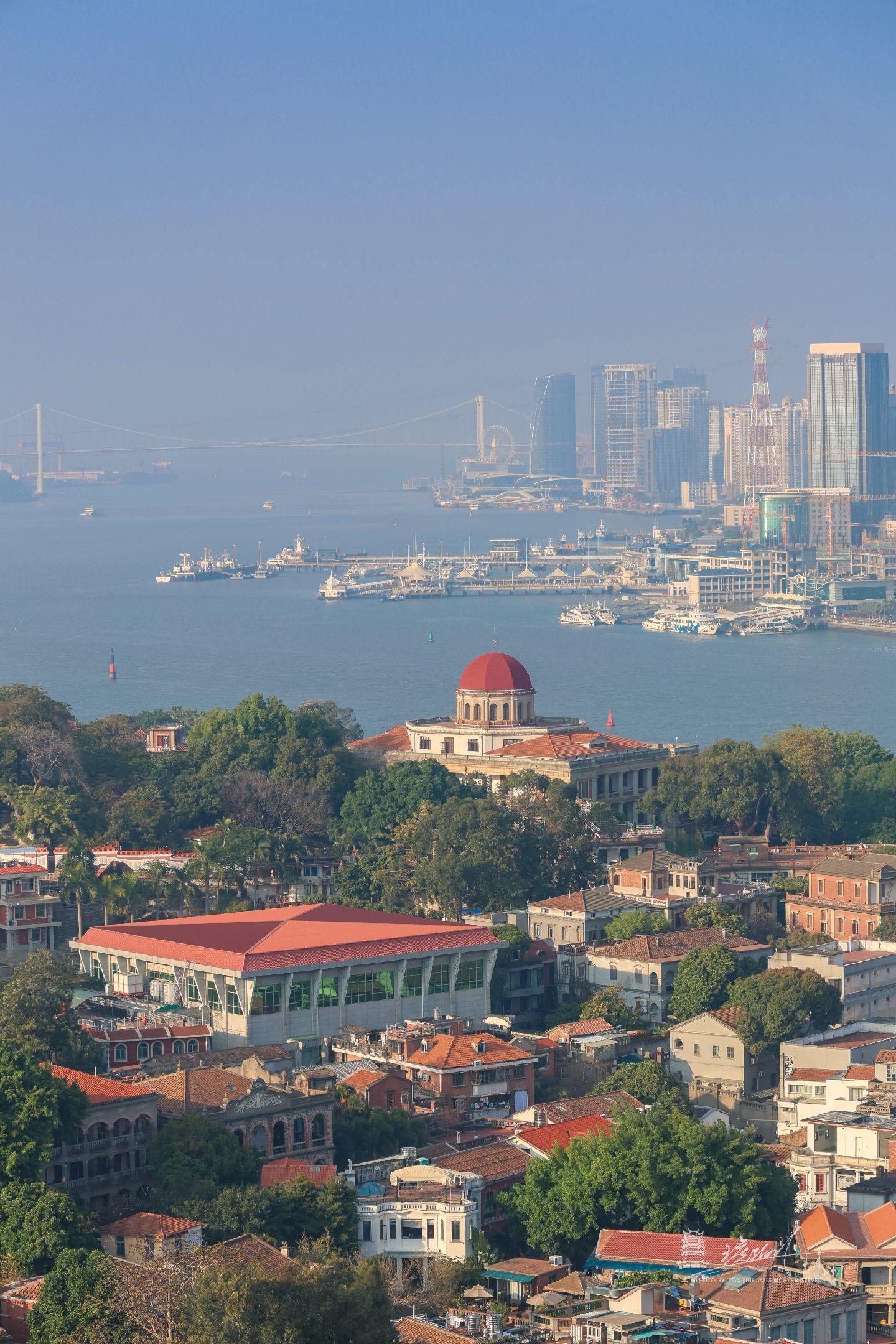
At the top is Bagua Lou, the mansion with the red dome that you can see from Xiamen. It was begun in 1907 for a Taiwanese merchant who ran out of money building it. It reopened in February 2024 after restoration and holds the Organ Museum, whose centrepiece is a full-size Norman & Beard pipe organ. Entry rules have been changing, with some reports of a ¥30 ticket and others of free admission by reservation, so ask at the door.
10:30 — Across the middle
From Bagua Mansion, cut south through the residential lanes. There is no single correct path. Follow signs for Shuzhuang Garden and take whichever lane looks emptiest. This is the part of the island UNESCO was describing when it counted 931 historical buildings: villas behind high walls, banyans splitting the pavement, the occasional church. Many houses carry a small plaque with a name and date.
The style you will see most often has a name. Around the 1920s and 30s, returning emigrants built houses that mixed Western plans and decoration with local materials and motifs, and the result is now called Amoy Deco.
11:30 — Shuzhuang Garden and the Piano Museum
The garden sits on the southern shore. A Taiwanese merchant, Lin Erjia, built it in 1913 after leaving the island when Japan took it. Half the garden is a walkway that zigzags out over the sea on stone piers, the Forty-Four Bridge. The other half is a rockery riddled with tunnels that children can climb through.
The Piano Museum is inside, included in the ticket of about ¥30. The instruments were collected by Hu Youyi, a Gulangyu-born musician who settled in Australia. The island has long been known for producing pianists, which is where the nickname Piano Island comes from.
This is the most level and shaded of the main sights. If you are choosing only one to pay for, choose this.
12:30 — Lunch
The beach beside the garden, Gangzaihou, has places to sit. For food, walk ten minutes north to Longtou Road. It is the commercial street, crowded and unsubtle, and it is where the food is: oyster omelette, fish-ball soup, glutinous maci rolled in peanut and sesame, and a coconut or two. Eat, then leave.
14:00 — Sunlight Rock
By now the morning tour groups have been and gone. Sunlight Rock is the granite summit in the middle of the island, 92.7 metres above the sea. The ticket was about ¥50. The path passes a small temple built into the rock, then narrows to a steep staircase for the last ten to fifteen minutes. The platform at the top holds a limited number of people and staff control the flow.
The view is the one on every postcard: a sea of red-tiled roofs, the strait, and the towers of Xiamen beyond. If stairs are a problem, the terrace by the temple partway up has a good part of the view without the climb.
15:00 — Down to the pier
Walk downhill to Sanqiutian. If you have energy left, Haoyue Garden on the south-east point has a large granite statue of Koxinga, the Ming loyalist who used Xiamen as his base in the 1600s, looking out to sea. Entry was about ¥10.
Your return fare is included, from any pier. Boats run back until late.
The route at a glance
| Time | Stop | Cost | Walking |
|---|---|---|---|
| 8:30 | Consulate quarter, Lujiao Road | Free | Level |
| 9:30 | Bagua Mansion, Organ Museum | Check at door | Uphill |
| 10:30 | Residential lanes | Free | Up and down, steps |
| 11:30 | Shuzhuang Garden, Piano Museum | About ¥30 | Mostly level |
| 12:30 | Lunch, Longtou Road | Level, crowded | |
| 14:00 | Sunlight Rock | About ¥50 | Steep stairs |
| 15:00 | Haoyue Garden, then the pier | About ¥10 | Downhill |
A combined ticket for the five core sights was about ¥90 when we checked. On this route, paying singly for the garden and the rock costs a little less.
Shorter and longer versions
Half a day. Consulate quarter, straight to Shuzhuang Garden, lunch, pier. Skip the hill.
With an extra hour. The former Hope Hospital on the north shore now houses a branch of the Palace Museum showing foreign objects from the imperial collection. It is closed on Mondays and cost ¥50.
Staying the night. After the last day boats leave, the island empties and you have the lanes to yourself. Bear in mind that there is no transport for luggage beyond hand carts.
What to ignore
People will offer you speedboat rides, guided tours, discounted sight tickets and pearls from oysters opened in front of you. Visitors who took up these offers describe much the same afternoon, and it is not the one above. The island needs none of them.
If the weather turns
In rain, do the museums: the consulate exhibition, Bagua Mansion, the Piano Museum, the Palace Museum gallery. In fog or a typhoon warning the ferries stop, and the plan moves to another day. See our month-by-month guide.
Quick answers
How long do you need on Gulangyu?
Five to six hours for this route at an easy pace, including lunch. The paid sights alone take about half a day.
Which pier should I land at on Gulangyu?
Sanqiutian for a first visit. It is the closest to the old consulates and the main sights. Neicuo'ao, on the west side, is quieter but further from everything.
Do I need to buy the Gulangyu combined ticket?
Only if you plan to visit most of the five core sights. It cost about ¥90 when we checked. If you want only Shuzhuang Garden and Sunlight Rock, single tickets at about ¥30 and ¥50 come to less.
Is Gulangyu hilly?
Yes. The lanes rise and fall constantly and many have steps. The summit of Sunlight Rock is reached by a steep, narrow staircase. The seaside stretches and Shuzhuang Garden are the gentlest.
Can I take luggage to Gulangyu?
Leave it at the ferry terminal's storage desk. The island is stone paving and steps throughout, and there are no vehicles to help.
What time should I arrive on Gulangyu?
Before 8:30 if you can. The lanes fill from about 10, and midday in summer is hot with limited shade.
Keep planning
Sources we checked
- UNESCO World Heritage Centre: Kulangsu, a Historic International Settlement
- Xiamen Ferry Co.: tourist routes and fares (Chinese)
- Kulangsu Gallery of Foreign Artefacts from the Palace Museum: visitor information (Chinese)
- Xiamen Net: Bagua Mansion reopens after restoration, February 2024 (Chinese)
Last checked: October 2026. Tickets, ferries, opening hours and entry rules change; we confirm the current arrangement for your dates before you travel.
Walk Gulangyu with a guide
The buildings mean more when someone can tell you who lived in them. We can arrange the ferry in advance and a guide who knows the island's back lanes.