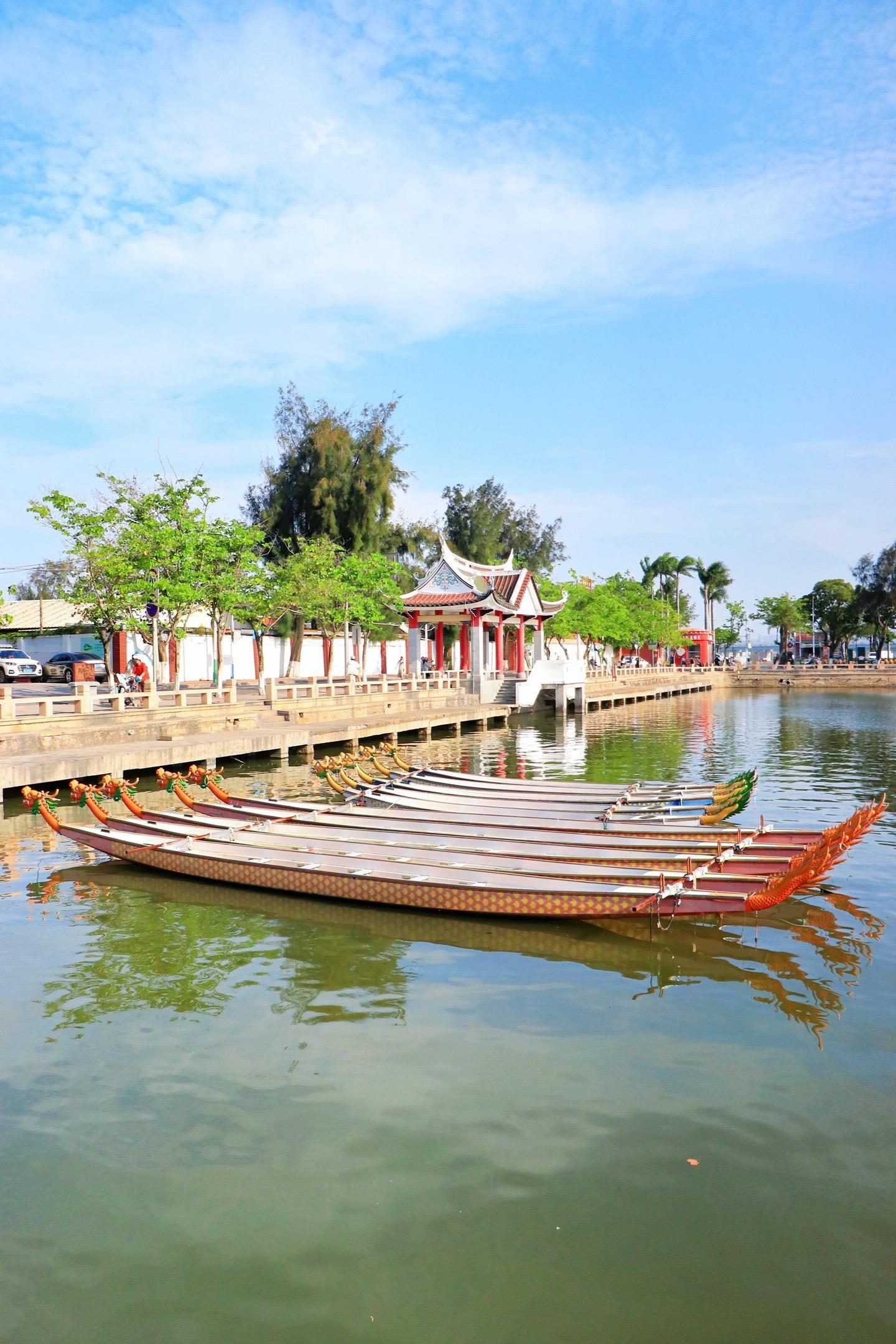
Ride Line 1 across the water to Jimei School Village station, walk to the Dragon Boat Pond, on to Jiageng Park and Aoyuan on the point, back through the lanes of Jimei Dashe, and eat on Shigu Road. Three to four hours. Stay for sunset on the dyke if the weather is clear.
The man behind it
Tan Kah Kee, Chen Jiageng in Mandarin, left Jimei for Singapore as a teenager and built a business empire there. From 1913 he poured the profits into his home village: a primary school first, then a middle school, a teachers' college, schools of navigation, commerce and agriculture. In 1921 he founded Xiamen University across the bay. He is buried in Jimei, in the seaside garden he designed.
The schools are still schools. Jimei University and several others occupy the buildings, and in term time the streets are full of students. That is a large part of why the district feels lived in, not staged.
Getting there is part of it
Jimei is on the mainland side of the strait, and Metro Line 1 reaches it by running along a causeway over open water. For a few minutes between Gaoqi and Jimei School Village stations there is sea on both sides of the train. Going north, the better view is from the right-hand windows.
The station itself is built in the local style, with a tiled roof. Leave by exit 2. Walkers put the Dragon Boat Pond a few minutes away.
If you are coming from or going to Xiamen North railway station, Jimei is on the way. It is a few stops down the same line, which makes it an easy first or last half-day.
A walking route
This loop follows the order most visitors settle on. It goes out along the water and brings you back through the old village.
1. The Dragon Boat Pond
A long rectangular lagoon that Tan Kah Kee had built in 1950 on reclaimed land for dragon boat racing, with seven pavilions along its banks. School buildings stand all around it. The one that draws the eye is Nanxun Lou, a fifteen-storey tower finished in 1959, with a green pagoda roof on top of what is otherwise a mid-century office block. It should not work and it does. Come in the morning, when the water is still enough to hold the reflection.
2. Jiageng Park and Aoyuan
Follow the shore south to the tip of the peninsula. Jiageng Park is a free seaside garden of lawns and pavilions. Beside it, on what was once a small island, is Aoyuan, the Turtle Garden.
Aoyuan is the heart of Jimei. You enter along a covered corridor fifty metres long, lined with fifty-eight carved stone panels. Beyond it a tall granite monument faces the sea, and behind that is Tan Kah Kee's tomb, built in the traditional southern Fujian form. The walls around the enclosure are covered, every surface, in relief carvings: scenes from history, plants, animals, machines, even diagrams of hygiene and exercise. He intended it as an open-air textbook for people who could not read.
Entry is free. Opening hours are 8:00 to 17:30 in the cooler months and to 18:00 in summer. One recent visitor says a reservation through the official account was needed, so check when you arrive.
3. The Memorial Museum and the old residence
The Tan Kah Kee Memorial Museum, close to Aoyuan, tells the story in more detail. It is free and closed on Mondays. Allow forty minutes. His modest former house is nearby.
4. Jimei Dashe
Walk inland and the school buildings give way to something much older. Dashe is the original village, about seven hundred years old, a tangle of lanes between red-brick courtyard houses with the upswept “swallow-tail” roof ridges of southern Fujian. Small cafes, a village opera stage and a good deal of street art have moved in without pushing the residents out. Laundry still hangs across the alleys.
Chinese visitors come looking for one particular house, used in a 2009 television drama. You will know it by the queue.
5. Shigu Road
The eating street, running back towards the station. It is student food, cheap and filling. Shacha noodles are the staple. Also look for vermicelli with duck, taro pastries baked to order, and siguotang, a bowl of shaved ice with beans and jelly.
6. The long dyke
Near the station, Shili Changdi, the “ten-li dyke”, runs along the water facing west. It is where Jimei goes to watch the sun set, around 6:30 in early autumn, with the metro trains crossing the causeway in silhouette. Buskers set up in the evening.
How much walking?
More than it looks on a map. Visitors who did the full circuit on foot, with stops, counted five to six hours. The route above without the dyke is about half that.
The alternative is two wheels. Shared and rental electric bikes are everywhere outside the station. One traveller on an airport stopover paid ¥35 for three hours. Use one of the big-name shared brands if you can: people report trouble getting deposits back from informal street renters.
The ground is level throughout, which makes Jimei one of the kinder outings for children and older travellers. There is not much shade on the waterfront. In summer, go after four.
When to go
Any dry day. Weekday mornings are quiet. On public holidays the lanes around Shigu Road clog with cars and parking is close to impossible, so take the metro.
The Dragon Boat Festival, in late May or June, is the one time the pond is used for what it was built for. Racing has been held here since the 1950s.
Jimei or Xiamen University?
People often ask which to choose. The university campus is more compact and has the sea on its doorstep, but getting in depends on a lottery. Jimei has more of the same architecture, an old village and a famous tomb, and you can simply walk in. If you fail to get a place at the university, come here and you will not have missed much. Our guide to visiting Xiamen University explains the lottery.
Fitting it into a trip
Jimei suits a third day in Xiamen, an arrival afternoon, or a few spare hours before a train. It also works as a long layover outing from the airport, which is only a few stops away: see our layover guide.
Quick answers
How do I get to Jimei School Village from Xiamen?
Take Metro Line 1 to Jimei School Village station and leave by exit 2. From the old town it is about 30 to 40 minutes. A car takes about the same outside rush hour.
Is Jimei School Village free?
Walking the district is free. Aoyuan and Jiageng Park are free to enter. The Tan Kah Kee Memorial Museum is free and closed on Mondays. Some sites ask for an advance reservation, so check on the day.
How long do you need in Jimei?
Half a day covers the waterfront, Aoyuan and the old village at an easy pace. Stay until evening if you want the sunset from the long dyke.
What is the Jiageng style?
The architecture Tan Kah Kee used for his schools: Western masonry walls with arcades and columns, topped by southern Fujian roofs of glazed tile with upturned swallow-tail ridges. Locals call it a Western suit with a bamboo hat.
Is Jimei worth visiting?
Yes, especially if you could not get a place in the Xiamen University visitor lottery. It has the same architecture, more of it, and no reservation to walk around.
Is Jimei suitable for children and older travellers?
It is one of the easier places in Xiamen: flat, open and by the water. The whole circuit is long on foot, so shorten it or ride part of the way.
Keep planning
Sources we checked
Last checked: October 2026. Tickets, ferries, opening hours and entry rules change; we confirm the current arrangement for your dates before you travel.
Adding Jimei to your trip
Jimei pairs well with an arrival or departure day, since it lies between the island and Xiamen North station. Tell us your dates and we can fit it in.