Start at the upper Tianluokeng viewpoint by 10 am, walk down into the cluster, drive on to Yuchang Lou and Taxia for lunch, then cross to Yunshuiyao for the afternoon. Two tickets at ¥90 each. Leave Yunshuiyao by 4:30 to be back in Xiamen for dinner.
How the area is laid out
Nanjing county's tulou are sold as two routes, each with its own ticket and its own shuttle bus.
- The Tianluokeng route: the Tianluokeng cluster, Yuchang Lou and Taxia village, strung along about 7 km of mountain road.
- The Yunshuiyao route: the old village path with Hegui Lou and Huaiyuan Lou, about 30 minutes away by road.
With your own car and driver you move between stops as you like. Without one, a scenic-area shuttle runs each route from its reception centre for ¥15.
Tianluokeng
The name means “snail pit”. The cluster sits on a shelf halfway up a steep, terraced valley: a square building, Buyun Lou, first built in 1796, with three round ones and an oval one placed around it over the following 170 years. The last, Wenchang Lou, was finished in 1966. All five belong to one clan.
The two viewpoints
There is an upper platform on the road above the cluster and a lower one below it. Go to the upper one first. From here you see all five roofs at once against the terraces, the view that earned the “four dishes and one soup” name. A visitor who went in February 2024 counted about ten minutes of steps to reach the overlook.
Morning light is best. By late morning tour buses arrive and the platform fills.
Inside
From the platform a path leads down into the village. The buildings are homes. Ground floors are kitchens and tea stalls, and the upper floors are storerooms and bedrooms. Residents will invite you to sit and taste tea, which they sell. Visitors are generally asked to stay on the ground floor.
The lower viewpoint, beyond the village, looks back up at the walls.
Yuchang Lou
About 4 km down the road. From outside it is one more round earth building, five storeys and 18 metres high with 270 rooms. Step in and look up at the galleries. The upright posts on the third and fourth floors lean one way and those on the fifth lean the other, by as much as fifteen degrees. The story told locally is that the carpenters mismeasured. The building is about seven hundred years old by local tradition, so whatever happened, it holds.
Yuchang Lou is not itself on the World Heritage list, though it is on the ticket. It also has something practical: a well inside each ground-floor kitchen.
Taxia
Another 3 km. Taxia is a clan village along a fast stream, with stone bridges, a mix of round and square tulou and ordinary houses, and an ancestral temple fronted by a forest of carved stone poles raised to honour successful sons. It is the calmest stop on the route and has the most places to eat.
This is also where most people who stay overnight in the Nanjing area sleep. See staying in a tulou.
Yunshuiyao
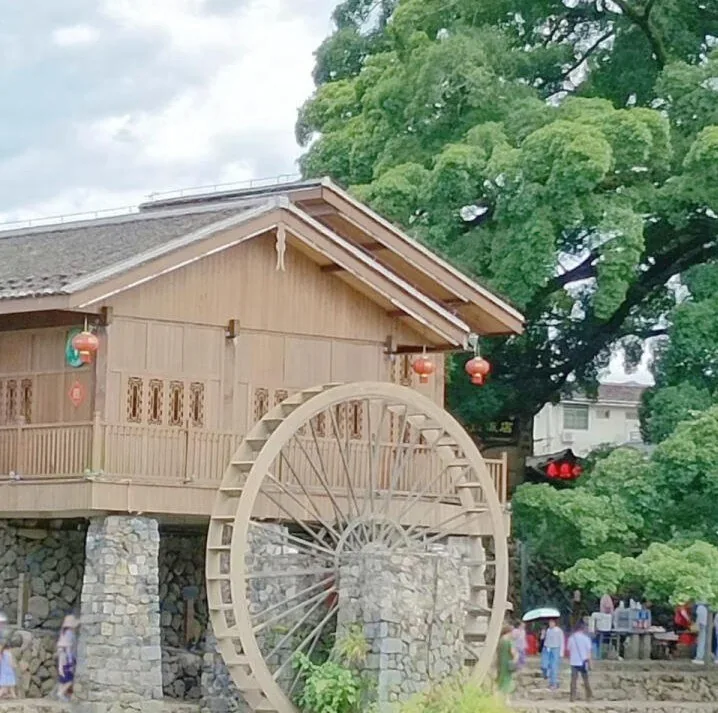
Half an hour away by road, in the next valley. The village used to be called Changjiao. It was renamed after a 2006 film, The Knot, known in Chinese as Yun Shui Yao, was partly shot here. The wooden water wheel built for the film still stands by the river and is the most photographed object in the place.
What is old is the path. A cobbled track follows the river under a line of banyan trees, some of them enormous, for about a kilometre and a half. It was part of a trade route through the hills. Shops and tea houses in old timber buildings face it.
Hegui Lou
A square tulou of 1732, five storeys and 21.5 metres high, the tallest of its type. It was built on a swamp. Residents will show you a spot in the courtyard where the ground gives under your feet, and tell you the building floats on a raft of pine logs.
Huaiyuan Lou
A round tulou of 1909, four storeys, 38 metres across. It is small by the standards of the area and unusually well kept, with a school room at its centre and carved woodwork around the inner court.
Both are on the World Heritage list. A visitor in 2026 also recommended two buildings off the ticket: one with a courtyard that throws a crescent-shaped shadow, and one converted into a guesthouse that charges a separate fee to look round.
Tickets and transport
| Item | Price | Notes |
|---|---|---|
| Tianluokeng route | ¥90 | Cluster, Yuchang Lou, Taxia. ¥100 on some platforms in 2026 |
| Yunshuiyao route | ¥90 | Hegui Lou, Huaiyuan Lou, old path |
| Hekeng cluster | ¥40 | Separate site, no bus |
| Scenic shuttle | ¥15 per route | Sold separately from the gate ticket |
The gate prices come from a provincial notice of 2020 and were still being quoted in 2025. Published concessions are free entry for those 65 and over and children 6 and under, and half price from 60 to 64 and for students. These are written for Chinese ID holders, and we have not confirmed how they are applied to foreign passports.
The villages can be entered at any hour. Ticket checks run from about 8:30 to 17:30.
A day, hour by hour
| Time | Stop |
|---|---|
| 7:30 | Leave Xiamen |
| 10:00 | Tianluokeng upper viewpoint, then down into the cluster |
| 11:15 | Yuchang Lou |
| 12:00 | Taxia: lunch and a walk along the stream |
| 13:30 | Drive to Yunshuiyao |
| 14:00 | Old path, Hegui Lou, Huaiyuan Lou |
| 16:30 | Leave for Xiamen |
| 19:00 | Back in the city |
If you are coming by train and bus, you will manage one route, not both. Yunshuiyao is the easier of the two to reach. Our page on getting from Xiamen to the Tulou has the details.
Things worth knowing
- Lunch in Taxia or Yunshuiyao is simple country cooking, typically chicken, bamboo shoots, river fish and greens, with local tea.
- The tea sold in doorways is mostly local oolong and black tea. Tasting is free and buying is not required.
- After rain the cobbles and the steps at Tianluokeng are slick.
- Spring is when the terraces are greenest. It is also the wettest time of year.
- On public holidays the road to Tianluokeng queues. Start even earlier, or go the day after.
Quick answers
What is 'four dishes and one soup'?
The nickname of the Tianluokeng cluster: one square tulou in the middle with three round ones and an oval one around it, which from above look like dishes set on a table.
How much is the ticket for Tianluokeng?
¥90 under the provincial price notice, covering the Tianluokeng cluster, Yuchang Lou and Taxia village. Some booking platforms showed ¥100 in 2026. The shuttle bus is ¥15 extra.
How much is the ticket for Yunshuiyao?
¥90, covering Hegui Lou, Huaiyuan Lou and the old riverside path.
How long do you need at Tianluokeng and Yunshuiyao?
Two to four hours for the Tianluokeng route and about two hours for Yunshuiyao, plus half an hour between them.
Is there a lot of walking?
Moderate. The Tianluokeng overlook involves about ten minutes of steps. Yunshuiyao is mostly a level riverside path.
Why is Yuchang Lou famous?
Its internal wooden posts lean by up to about 15 degrees, in opposite directions on different floors, and have done for centuries.
Keep planning
Sources we checked
- UNESCO World Heritage Centre: Fujian Tulou
- Fujian Development and Reform Commission: Nanjing tulou ticket and shuttle prices, 2020 (Chinese)
- Fujian Provincial Government: the film locations of Yunshuiyao, July 2024 (Chinese)
Last checked: October 2026. Tickets, ferries, opening hours and entry rules change; we confirm the current arrangement for your dates before you travel.
See the Nanjing Tulou with a guide and car
We can arrange the drive from Xiamen, tickets and an English-speaking guide, and pace the day to the people travelling.