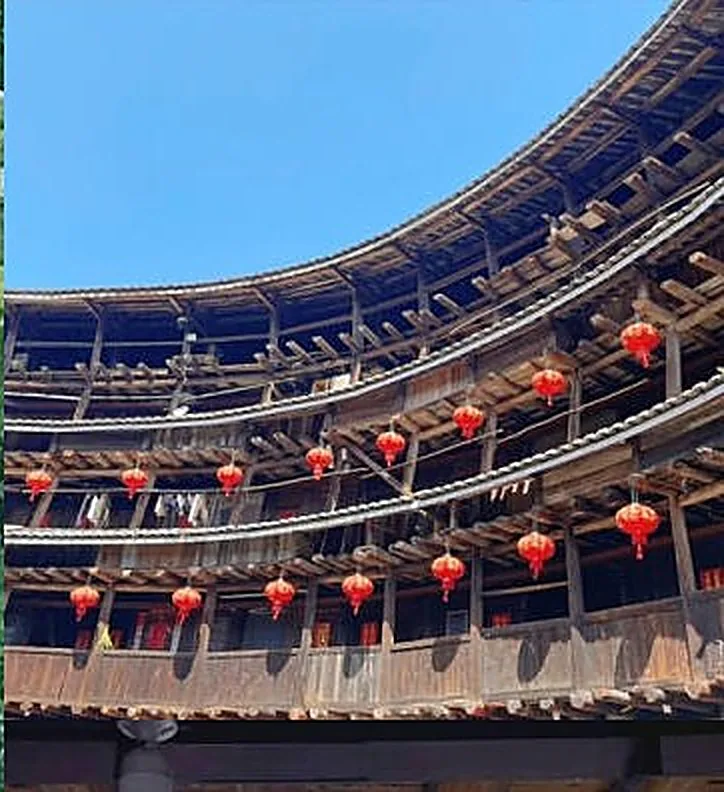
One day from Xiamen: Nanjing county, for Tianluokeng and Yunshuiyao. Two days: add Yongding for Chengqi Lou and Zhencheng Lou, the two grandest buildings, and sleep in a village between. If you only want one building to remember, it is in Yongding. If you want the photograph, it is in Nanjing.
What you are choosing between
A tulou is a fortified communal house. Thick outer walls of rammed earth, three to five storeys high, enclose a courtyard, with rooms for dozens of related families stacked in rings around it. They were built from roughly the 15th century to the 20th, some round, many square. UNESCO describes the largest as housing up to 800 people.
The inscribed buildings fall into ten sites. Visitors go to two groups of them, in neighbouring counties.
| Nanjing county | Yongding district | |
|---|---|---|
| From Xiamen by road | 2–3 hours | 2.5–3.5 hours |
| Main sites | Tianluokeng, Yunshuiyao, Hekeng | Hongkeng, Gaobei, Chuxi |
| Built by | Mostly Minnan-speaking clans | Hakka clans |
| Strength | Setting: clusters seen from above, a riverside village | Individual buildings: the biggest, the most elaborate |
| Feel | Scenic, spread along a valley | Denser, more commercial at Hongkeng |
| Tickets | ¥90 + ¥90, Hekeng ¥40 | ¥90 + ¥50, or ¥98 combined |
Nanjing county
Tianluokeng
Five buildings on a hillside: one square, three round, one oval, arranged so neatly that the group is nicknamed “four dishes and one soup”. The square one in the middle dates from 1796. The others were added between the 1930s and 1966. You look down on them from a viewing platform above the road, and this is the picture on the cover of every book about the Tulou. Then you walk down and go inside.
Yuchang Lou
A few kilometres on. A five-storey round building, about seven centuries old by local tradition, whose interior posts lean alarmingly: one way on the third and fourth floors, the other way on the fifth, by as much as fifteen degrees. It has stood like that for a very long time.
Taxia
A village strung along both banks of a stream, with tulou and ordinary houses mixed together and stone bridges between them. It is on the same ticket as Tianluokeng and is the usual place to stop for lunch or the night.
Yunshuiyao
Half an hour away, on a different river. An old cobbled path runs under huge banyans past a water wheel to two inscribed buildings: Hegui Lou, a square tulou of 1732 built on marshy ground, and Huaiyuan Lou, a compact round one of 1909 with fine woodwork. The village took its present name from a 2006 film shot here.
Hekeng
Thirteen inscribed buildings packed into a small valley, with a free hillside viewpoint and very few visitors. It is the least developed of the Nanjing sites and has no public bus.
We cover the first four in detail in our Tianluokeng and Yunshuiyao guide.
Yongding
Chengqi Lou, Gaobei
Called the king of the tulou. Built in 1709, it has four concentric rings, the outermost four storeys high with 288 rooms, some 370 rooms in all, and an ancestral hall at the centre. Jiang-clan families still live in it. Walk through the gate and you see ring within ring, which explains what a tulou is better than any diagram.
Zhencheng Lou, Hongkeng
The prince to Chengqi's king. Built in 1912 by the family of a tobacco merchant, it is the most refined of the big round houses. The outer ring is divided into eight segments on the pattern of the Eight Trigrams, and the central hall has Greek-style columns and wrought-iron balustrades, which says something about where the money had been made.
Kuiju Lou and Fuyu Lou, Hongkeng
Hongkeng is a whole village of tulou along a stream. Kuiju Lou, finished in 1834, is a square building in a stepped, palace-like form. Fuyu Lou, from 1880, is in the “five phoenix” style, with roofs rising in tiers, and part of it operates as a guesthouse.
Chuxi
The furthest out and the quietest. Its oldest building, Jiqing Lou, dates from 1419 and has seventy-two separate staircases, one for each household, so that no family had to cross another's space.
Hongkeng and Gaobei are about 4 km apart, ten minutes by road. Chuxi is 25 minutes or more beyond.
How to decide
You have one day. Nanjing. It is closer, and the sights lie along one road. Trying to reach Yongding and back in a day leaves little time on the ground. See how to get there.
You have two days. Do both. Day one in Nanjing, night in Taxia or Yunshuiyao, day two across the hill to Gaobei and Hongkeng, and back to Xiamen in the evening.
You care about architecture. Yongding first. Chengqi Lou and Zhencheng Lou are the most complete large buildings open to visitors.
You care about photographs and landscape. Nanjing. The Tianluokeng overlook and the Yunshuiyao riverside are the scenes.
You dislike crowds. Hekeng or Chuxi, the least visited site in each county.
You are travelling with children or older relatives. Nanjing, with a night nearby to break the drive. Yunshuiyao is level walking by a river.
What they have in common
All of these are lived-in villages run as ticketed scenic areas. Residents sell tea, dried fruit and souvenirs from their doorways. In most buildings visitors are asked to stay on the ground floor. Going upstairs is sometimes allowed, occasionally for a small fee paid to the family. Midday in high season is busy everywhere. Early morning and late afternoon are when the courtyards are quiet, which is one reason to stay overnight.
Quick answers
Which tulou cluster is best for a day trip from Xiamen?
Nanjing county. It is the closer of the two, and Tianluokeng, Yuchang Lou, Taxia and Yunshuiyao fit into one day.
Which tulou are the most impressive?
For sheer size and interior detail, Chengqi Lou at Gaobei and Zhencheng Lou at Hongkeng, both in Yongding. For the view of a whole group in its landscape, Tianluokeng in Nanjing.
Can I see both Nanjing and Yongding in one day?
It can be done with a car and a very early start, but you will spend most of the day driving. Two days with a night in between is the comfortable way.
How far apart are the Nanjing and Yongding tulou?
The nearest clusters are roughly 30 to 45 minutes apart by mountain road. Published figures vary because the clusters are spread out.
Are all the tulou Hakka buildings?
No. The Yongding tulou were built by Hakka clans. Those in Nanjing county were built largely by Minnan-speaking people.
How much are tulou tickets?
Regulated prices set in 2020 and still quoted: Tianluokeng route ¥90, Yunshuiyao ¥90, Hekeng ¥40 in Nanjing; Hongkeng ¥90, Gaobei ¥50, or ¥98 for both in Yongding. Shuttle buses are extra.
Keep planning
Sources we checked
- UNESCO World Heritage Centre: Fujian Tulou
- Fujian Development and Reform Commission: Nanjing tulou ticket prices, 2020 (Chinese)
- Fujian Development and Reform Commission: Yongding tulou ticket prices, 2020 (Chinese)
Last checked: October 2026. Tickets, ferries, opening hours and entry rules change; we confirm the current arrangement for your dates before you travel.
Not sure which cluster fits your trip?
Tell us how many days you have and how you feel about long drives. We can suggest a route and arrange the car and guide.