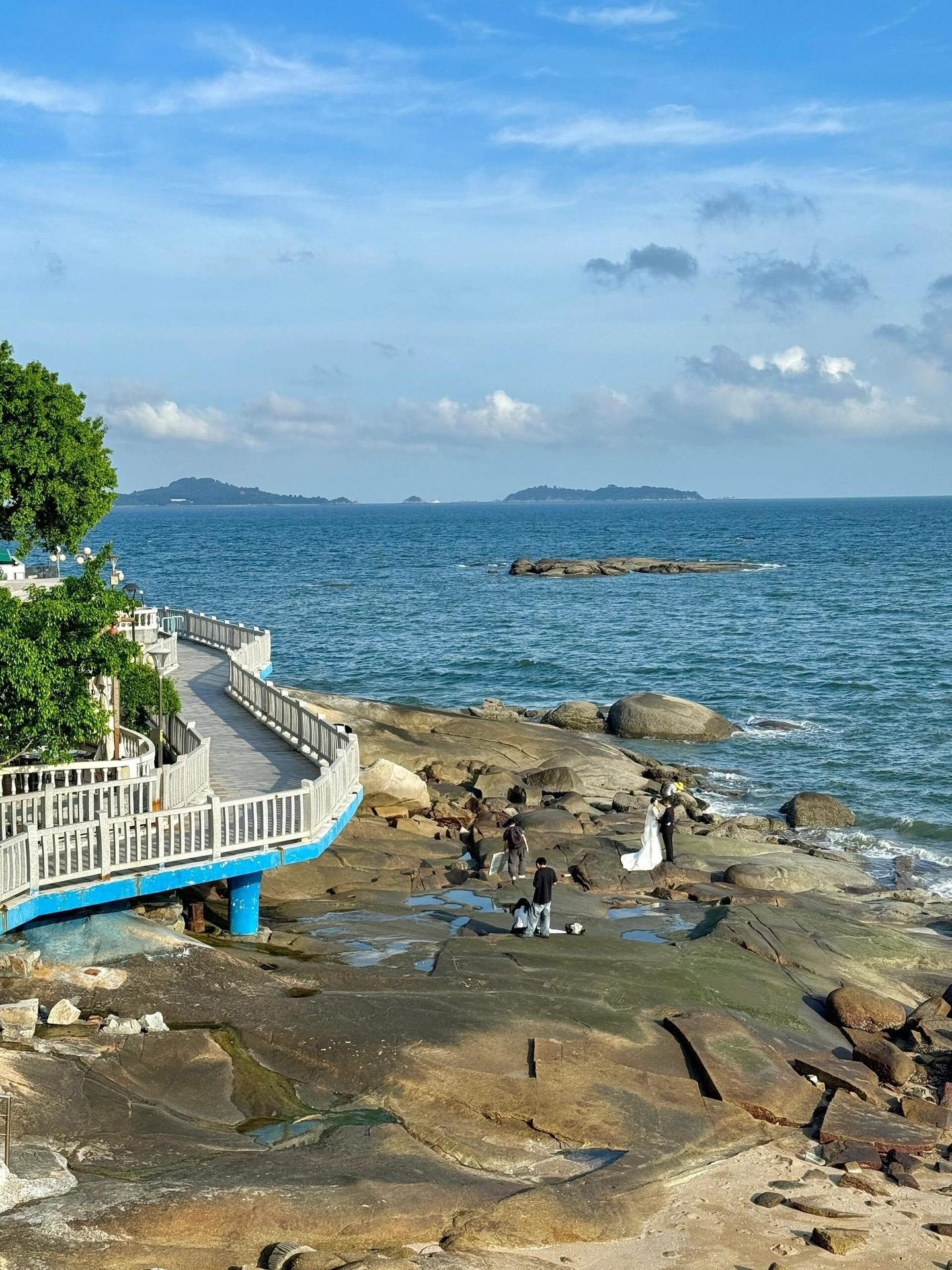
Days 1–2 Xiamen and Gulangyu. Day 3 to the Tulou, sleeping in a village. Day 4 back through the hills to Quanzhou. Day 5 Quanzhou in the morning, train to Wuyishan. Days 6–7 Wuyishan, then the direct train back to Xiamen, or onward to Fuzhou and out.
The shape of the week
| Day | Where | Main thing | Sleep |
|---|---|---|---|
| 1 | Xiamen | Arrive; Nanputuo, Shapowei, seafront | Xiamen |
| 2 | Xiamen | Gulangyu; old town in the evening | Xiamen |
| 3 | Tulou | Yunshuiyao, Tianluokeng, Yuchang Lou | Taxia |
| 4 | Tulou to Quanzhou | Chengqi Lou and Hongkeng; drive to Quanzhou | Quanzhou |
| 5 | Quanzhou to Wuyishan | Kaiyuan Temple, West Street, mosque; afternoon train | Wuyishan |
| 6 | Wuyishan | Nine-Bend Stream raft; Tianyou Peak | Wuyishan |
| 7 | Wuyishan | Da Hong Pao valley walk; train out | Xiamen or onward |
Tour operators sell much the same sequence, usually over seven or eight days and usually ending in Wuyishan or Fuzhou. Closing the loop back to Xiamen is easy because the train is direct.
Days 1 and 2: Xiamen
Use the arrival day for the south-west corner of the island: Nanputuo Temple, the old harbour at Shapowei, and a walk on the seafront at sunset. Put Gulangyu on day two, with the old town and Zhongshan Road in the evening. If fog or wind stops the ferry, swap the two days. Our two-day plan has the detail, and this page covers the tickets.
Day 3: into the hills
Leave Xiamen by car at about eight. Two and a half hours later you are in Nanjing county. See Yunshuiyao first, then the Tianluokeng cluster in the softer afternoon light, with Yuchang Lou on the way down. Sleep in Taxia. The day visitors leave by five and the village is yours.
See Tianluokeng and Yunshuiyao and staying in a tulou.
Day 4: Yongding, then the coast
Go to the Tianluokeng viewpoint early if you missed the morning light. Then cross to Yongding, 30 to 45 minutes away, for Chengqi Lou at Gaobei and Zhencheng Lou at Hongkeng, the two grandest buildings. After lunch, drive to Quanzhou. It is a long afternoon in the car, roughly three hours, and you arrive in time for dinner on West Street with the pagodas lit.
If that sounds like too much driving, drop Yongding, spend the morning in Taxia and take the shorter road to Quanzhou.
Day 5: Quanzhou, then north
Be at Kaiyuan Temple when it opens. Walk West Street, then Tumen Street for the Qingjing Mosque and the two temples beside it. That is a morning. If you have a car until midday, add Luoyang Bridge. Our Quanzhou guide describes each.
In the afternoon take a train to Wuyishan North. Direct services run from Quanzhou East and Quanzhou South, not from the central station, and the fastest takes just under two hours. Allow 40 to 50 minutes to reach either station by taxi.
Days 6 and 7: Wuyishan
Wuyishan is the inland counterweight to everything before it: river gorges, red sandstone cliffs and tea. UNESCO lists it for both nature and culture. The scenic area is compact and run on a shuttle-bus system, since private cars are not allowed in.
The raft
The thing to do, and the thing to book. Bamboo rafts poled by two boatmen drift for about nine kilometres down the Nine-Bend Stream between cliffs that rise 200 to 400 metres from the water. It takes around an hour and a half and cost ¥130 when we checked. Seats are sold by real-name booking through the park's own mini-program and sell out in season. Rafting stops when the river is high after heavy rain.
Tianyou Peak
The classic viewpoint, 408.8 metres high, reached by a one-way stone staircase of more than 800 steps. From the top you look straight down on the river bends you have just floated through. Allow an hour and a half to two hours. It is steep.
The Da Hong Pao valley
On the second day, walk the tea valley. Wuyi rock tea, an oolong, grows in pockets of soil between the cliffs, and the most famous name in it is Da Hong Pao. Six ancient bushes cling to a ledge in a gorge called Jiulongke. They have not been picked since 2006. In 2005, twenty grams from them sold at auction for ¥208,000. You look at them from below, then follow a trail through the tea gardens to a monastery and on to the Water Curtain Cave, an overhanging cliff with a thread of falling water. The walk takes an hour or two.
Tickets
The main gate ticket has been waived since 2023 in successive short-term announcements. The latest we could confirm ran to 31 March 2026. It may well still be free when you go, but check. The sightseeing bus costs ¥70 for one day, ¥85 for two, and is in practice compulsory.
The booking system is built for Chinese ID numbers. We have not confirmed that it accepts foreign passports, so have a Chinese speaker or an agency make the raft booking.
Getting back
Direct trains run from Wuyishan North to Xiamen North, the fastest in about 2 hours 10 minutes. Check the station on your ticket: there are two high-speed stations in the area, Wuyishan North, about 20 minutes from the scenic area, and Nanpingshi, about 35.
The alternative is to keep going. Fuzhou, the provincial capital, is under an hour from Wuyishan North by the fastest trains and has an international airport. Its old quarter, Sanfang Qixiang, is 40 hectares of Ming and Qing courtyard houses on a street plan that goes back to the Tang.
Train times, in one place
| Leg | Fastest train | Note |
|---|---|---|
| Xiamen North → Quanzhou | 17–26 min | Three Quanzhou stations; see the Quanzhou guide |
| Quanzhou East/South → Wuyishan North | About 1 h 55 min | Direct |
| Quanzhou → Fuzhou | About 40 min | |
| Fuzhou → Wuyishan North | About 55 min | |
| Wuyishan North → Xiamen North | About 2 h 10 min | Direct |
Times are the fastest we found in October 2026. Tickets go on sale about 15 days ahead. The Tulou leg has no railway and is done by road.
What to book ahead
- The Gulangyu ferry, for a morning sailing.
- The guesthouse in the Tulou, confirming that it can register a foreign passport.
- The Nine-Bend Stream raft.
- Train seats, if your dates touch a public holiday.
When to go
October is the month when everything lines up: dry on the coast, clear in the mountains. Avoid the first week. April and May are beautiful at Wuyishan and in the Tulou hills, with new tea being picked, but they are wet, and fog can delay the Gulangyu ferry. July to September brings typhoons to the coast and heavy rain inland.
With fewer days
Five days: drop Wuyishan. Xiamen two days, Tulou overnight, Quanzhou, back to Xiamen.
Four days: Xiamen two days, Tulou as a day trip, Quanzhou as a day trip.
Our guide to how many days to spend in Xiamen covers the shorter stays.
Visa-free travellers
Everything on this route is inside Fujian Province. For travellers who enter at Xiamen on the 240-hour visa-free transit, the whole province is the permitted area, and Wuyishan and Fuzhou airports are both eligible ports, so you can leave from the north without coming back.
Quick answers
How many days do you need for Fujian?
Seven days covers Xiamen, the Tulou, Quanzhou and Wuyishan comfortably. Five days is enough if you leave out Wuyishan.
How do you get from Xiamen to Wuyishan?
By direct high-speed train from Xiamen North to Wuyishan North or Nanpingshi. The fastest took about 2 hours 10 minutes when we checked in October 2026.
Is Wuyishan worth adding to a Xiamen trip?
Yes if you have two spare days and like walking. The bamboo-raft trip down the Nine-Bend Stream and the tea cliffs are unlike anything on the coast.
Is Wuyishan free to enter?
The main gate ticket has been waived in renewable blocks since 2023, most recently confirmed for the first quarter of 2026. Check whether the waiver is still running. The sightseeing bus and the raft are always charged.
Can I do this route on the 240-hour visa-free transit?
The whole route lies inside Fujian Province, which is the permitted stay area for travellers who enter through Xiamen. Seven days fits within the ten-day limit.
What is the best time of year for this itinerary?
October and November for the coast, and April to May or September to October for Wuyishan. October suits both.
Keep planning
Sources we checked
- UNESCO World Heritage Centre: Mount Wuyi
- UNESCO World Heritage Centre: Quanzhou, Emporium of the World in Song-Yuan China
- UNESCO World Heritage Centre: Fujian Tulou
- UNESCO World Heritage Centre: Kulangsu, a Historic International Settlement
- Wuyishan National Park Administration: Tianyou Peak (Chinese)
- China News Service Fujian: Wuyishan free-entry policy, February 2026 (Chinese)
- Fujian Provincial Government: Fujian under the 240-hour transit policy (Chinese)
Last checked: October 2026. Tickets, ferries, opening hours and entry rules change; we confirm the current arrangement for your dates before you travel.
Want this week arranged?
We can book the trains, the raft, the car for the Tulou and an English-speaking guide, and adjust the route to your dates and pace.