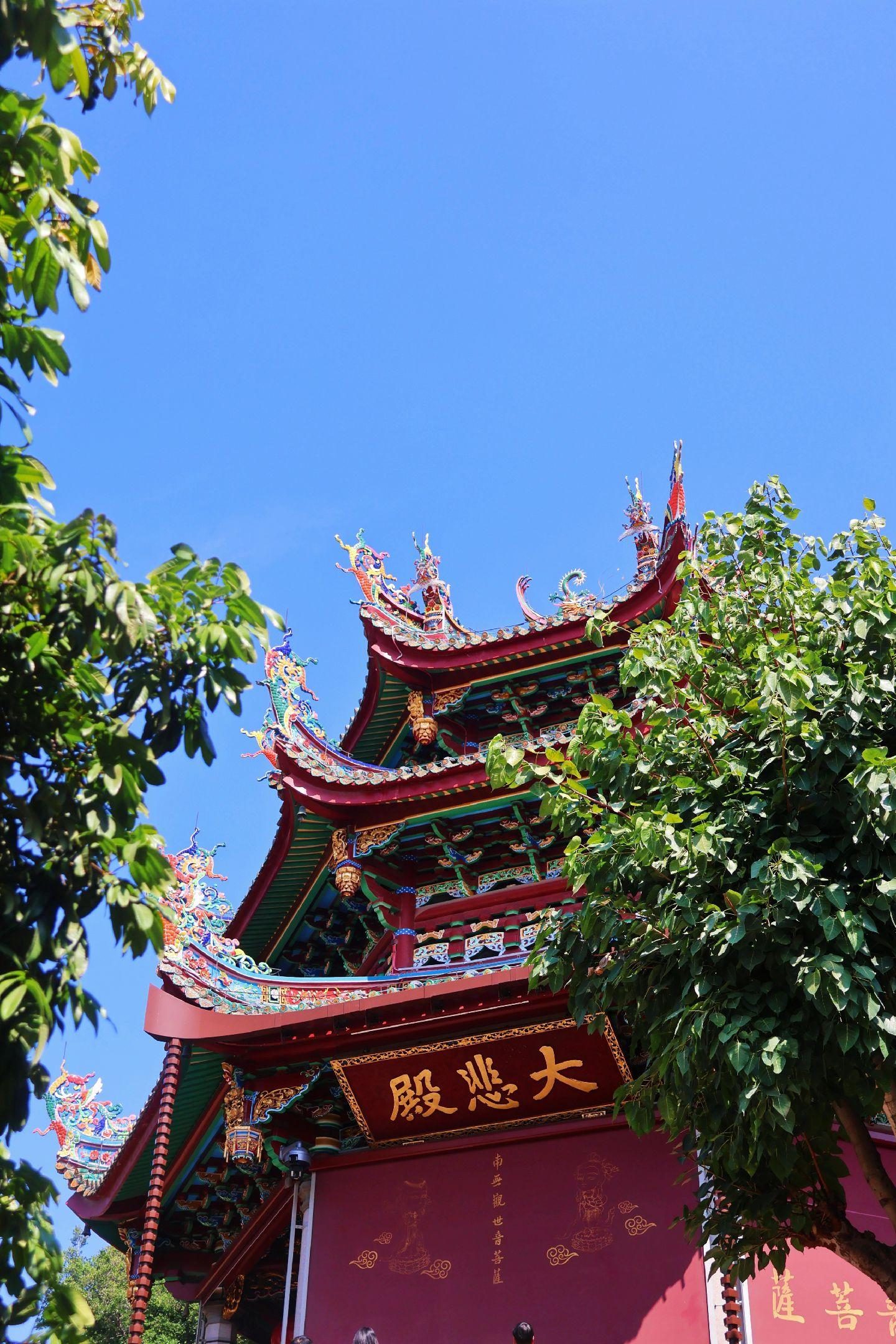
Book a train to the station named exactly “Quanzhou”, or go by car. Spend the morning at Kaiyuan Temple and on West Street, walk Tumen Street past the mosque after lunch, and finish at Luoyang Bridge or Xunpu village. One full day.
Getting there, and the station trap
Quanzhou has three stations, and the booking apps treat them as one city.
| Station | From Xiamen North | To the old town by taxi |
|---|---|---|
| Quanzhou (泉州) | About 26 minutes | 15–25 minutes |
| Quanzhou East (泉州东) | About 23 minutes | About 40 minutes |
| Quanzhou South (泉州南) | About 17 minutes | About 50 minutes |
The fastest trains use the new high-speed line and stop at East or South, which are in neighbouring towns. You save nine minutes on the train and lose half an hour in a taxi. Choose a service whose destination reads Quanzhou with nothing after it.
By road it is about an hour and a half from Xiamen. With four or more sights on the list, some of them 10 km from the centre, a car for the day is the easier way to do it.
The old town
Kaiyuan Temple
The largest Buddhist temple in Fujian, founded in the 680s. Two things make it more than another large temple.
The first is the pair of stone pagodas in the forecourt. The eastern one, rebuilt in stone in 1238, stands 48 metres. The western is 44 metres. They are carved to imitate timber construction, down to the brackets, and are the tallest pair of stone pagodas in China.
The second is easy to miss. Set into the base of the main hall and standing behind it are carved stone panels and columns showing Hindu deities. They came from a temple built by Tamil merchants in 1283, and were reused here after it fell into ruin. There is no clearer evidence of who lived in this city.
Entry is free and no booking is needed. Go early.
West Street
Xijie runs for 1.7 km from the Bell Tower past the temple gate. A street has been here since the 8th century. Today it is low red-brick buildings, snack shops and rooftop cafes whose selling point is the view of the two pagodas. It is touristy and enjoyable. Eat here.
Things to order: mianxianhu, a vermicelli porridge in seafood broth; runbing, fresh spring rolls; beef soup made with meat beaten into a soft paste; ginger duck; and peanut soup.
Tumen Street: a mosque and two temples
A short ride or a longer walk from West Street. Close together here are buildings of three faiths.
The Qingjing Mosque, also called the Ashab Mosque, is dated to 1009 and is described by UNESCO as one of the earliest Islamic buildings in China. What stands is roofless: a high stone gateway with a pointed arch, and the walls and columns of the prayer hall open to the sky. Entry was ¥3, paid at the gate.
Next to it, the Guandi Temple is as busy as the mosque is still. It is dedicated to Guan Yu, god of loyalty and of business, and it is thick with incense smoke at any hour.
Further south is the Tianhou Temple, founded in 1196 and dedicated to Mazu, protector of sailors. The city government calls it the earliest and largest surviving Mazu temple of its rank in China.
Out of the centre
You have time for one of these in a day, two with a car and an early start.
Luoyang Bridge
About 10 km from the old town. Built between 1053 and 1059 across a tidal estuary, it is 731 metres of granite beams on boat-shaped piers. The engineering is what impresses. The builders laid a raft of stones across the riverbed as a foundation, then seeded the piers with oysters, whose shells cemented the blocks together. Beams weighing over ten tonnes were floated into place on the tide. You can walk the length of it, free, at any hour.
Xunpu village
A fishing community near the mouth of the Jin River, known for two things. Its older houses have walls faced with large oyster shells, said to have come back as ballast in trading ships. And its women wear the zanhuawei: hair wound into a bun, pinned, and encircled with rings of fresh flowers. The custom is on the national heritage list. It went viral on Chinese social media a few years ago, and the village now receives up to 20,000 visitors on a peak day, most of them there to have the headdress put on and be photographed. Go on a weekday.
Laojun Rock
At the foot of Mount Qingyuan, 3 km north of the city. A Song-dynasty carving of Laozi, the founder of Taoism, cut from a single boulder: 5.6 metres high and 8 metres across, seated, with a long beard and very large ears.
The Maritime Museum
Founded in 1959, free, and closed on Mondays. It holds stone inscriptions and tombstones left by the foreign communities who lived in the medieval city. Its most famous exhibit, a Song-dynasty ocean-going ship excavated from Quanzhou Bay in 1974, is in a separate hall inside Kaiyuan Temple. That hall was reported closed for maintenance in 2024, so check before counting on it.
A day plan
| Time | Stop |
|---|---|
| 8:00 | Leave Xiamen by car, or take a train to Quanzhou station |
| 9:30 | Kaiyuan Temple |
| 11:00 | West Street; lunch |
| 13:00 | Tumen Street: mosque, Guandi Temple, Tianhou Temple |
| 15:00 | Luoyang Bridge, or Xunpu village |
| 17:00 | Return |
| 18:30 | Xiamen |
What “World Heritage” means here
UNESCO inscribed “Quanzhou: Emporium of the World in Song-Yuan China” in 2021. It is a serial site: 22 monuments and places, which UNESCO groups into 16 component parts, spread across the city and the surrounding counties. They include temples, the mosque, Islamic tombs, bridges, docks, pagodas that served as navigation marks, kiln sites and an iron works. The old town is one component. Luoyang Bridge and Laojun Rock are two more. You will not see all of them in a day and you do not need to.
Is it worth a day of a short trip?
If you have three days in Xiamen, we would keep them for the city and the Tulou. With five days, or a second visit, Quanzhou is the best thing you can add. It is more of a real working city than Xiamen, less polished, and the history is deeper. Our seven-day Fujian route gives it a full day and a night.
Quick answers
How far is Quanzhou from Xiamen?
About an hour and a half by car. By train, 17 to 26 minutes from Xiamen North depending on which Quanzhou station the train uses.
Which Quanzhou station should I book?
The one called simply Quanzhou (泉州). It is 15 to 25 minutes by taxi from the old town. Quanzhou East and Quanzhou South, used by the fastest trains, are 40 to 50 minutes out.
Is one day enough for Quanzhou?
One day covers the old town: Kaiyuan Temple, West Street, the mosque and the temples on Tumen Street, plus either Luoyang Bridge or Xunpu village. Two days lets you see the outlying sites.
Is Kaiyuan Temple free?
Yes. The Quanzhou tourism bureau states that no reservation is needed. It opens at 6:30, with last entry around 17:15.
Why is Quanzhou a World Heritage Site?
UNESCO inscribed it in 2021 as an outstanding example of a maritime trading port of the 10th to 14th centuries, represented by 22 sites and monuments.
What is the flower headdress in Quanzhou?
The zanhuawei, worn by the women of Xunpu, a fishing community near the river mouth: hair coiled in a bun and ringed with strings of fresh flowers. It is on China's national list of intangible cultural heritage.
Keep planning
Sources we checked
- UNESCO World Heritage Centre: Quanzhou, Emporium of the World in Song-Yuan China
- Quanzhou Municipal Government: Luoyang Bridge (Chinese)
- Quanzhou Culture and Tourism Bureau: Kaiyuan Temple visiting Q&A, February 2024 (Chinese)
- Quanzhou Municipal Government: Tianhou Temple (Chinese)
- China Intangible Cultural Heritage Network: customs of the Xunpu women (Chinese)
Last checked: October 2026. Tickets, ferries, opening hours and entry rules change; we confirm the current arrangement for your dates before you travel.
Quanzhou with a car and guide
The sights are scattered and the stories behind them are the point. We can arrange a private day from Xiamen with an English-speaking guide.