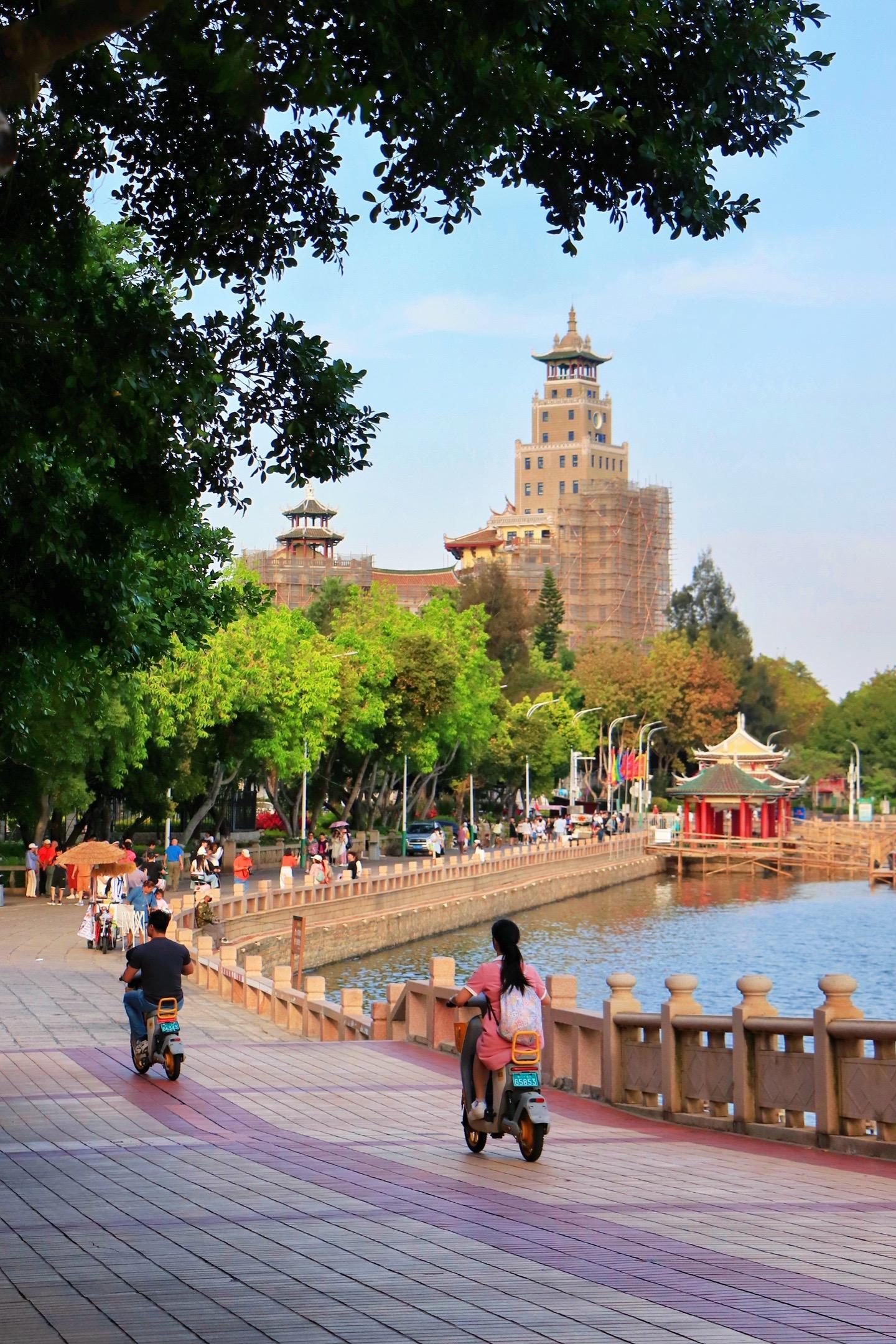
To see this side of Xiamen, spend an hour in a tea house, a morning in Jimei where Tan Kah Kee built his schools, and an hour at the Overseas Chinese Museum. If your family came from southern Fujian, add a day in Quanzhou or in the county your people left.
A port that sent things out
The Portuguese reached Xiamen in 1541. European ships traded here on and off for the next three centuries, and the 1842 Treaty of Nanjing named it one of the first five treaty ports. Foreigners called it Amoy, their rendering of how the name sounded in the local language.
Two things went out through it in quantity. One was tea. The other was people.
Tea
A word that travelled
In Mandarin the drink is cha. On this coast it is te. Dutch ships loading at Fujian ports took the local word home with the cargo, and from Dutch it passed into English, French, German and Spanish. Countries that received tea by the overland routes, from Russia to Turkey to Iran, say some form of chai. The split in the world's vocabulary is generally traced to which Chinese port your ancestors' tea was shipped from.
What is in the pot
Fujian is oolong country. Oolongs are partly oxidised, somewhere between green and black, and the province produces the two best-known families.
- Tieguanyin. From Anxi county, in the hills behind Quanzhou. It originated there in the 19th century. The leaves are rolled into tight green pellets that open in the pot, and the taste is floral and buttery. The spring and autumn pickings are the most prized.
- Wuyi rock tea. From the cliffs of Wuyishan, in the north of the province. Darker, roasted, mineral. Da Hong Pao is its most famous name.
You will also be offered white tea from the north-east of the province and jasmine tea from Fuzhou.
How it is drunk
Sit down in almost any shop, office or home in southern Fujian and someone will start making tea. The method is called gongfu, which means doing a thing with skill and time. It probably developed in the 18th century, in either the Wuyi Mountains or the neighbouring Chaoshan region.
- The pot or lidded bowl, no bigger than a fist, is rinsed with hot water to warm it.
- Leaves go in, a lot of them, and are rinsed quickly. That first water is poured away.
- The first proper infusion lasts ten or fifteen seconds.
- It is poured into a small jug so that every cup is the same strength, then into cups that hold two or three sips.
- Each round steeps a little longer. Good leaves give seven or eight.
Nobody rushes. The tea is an excuse for the conversation. As a guest, drink what you are poured and your cup will be refilled. Tapping two fingers on the table is a common way to say thank you.
If you buy, taste first. Any serious shop will brew what you are considering, and you are not obliged to buy afterwards. Prices range enormously and a high price is not a guarantee. Buy what you liked drinking.
People
The leaving
Southern Fujian is mountainous and was always short of farmland. From the 17th century onward, and in large numbers through the 19th and early 20th, men from these counties sailed for what the Chinese called Nanyang, the southern ocean: the Philippines, the Malay peninsula, Singapore, Java, Sumatra, Burma. Many went through Xiamen.
They took the language with them. Hokkien, the speech of this coast, is today spoken in Taiwan, Singapore, Penang, Medan, Manila, Cebu and many other cities. The varieties differ by where emigrants came from: Philippine Hokkien descends largely from the speech of the Quanzhou area, Penang's from Zhangzhou. A Hokkien speaker from Singapore can make themselves understood in a Xiamen market, and usually causes delight by trying.
The sending home
Those who prospered sent money back, with a letter, through private couriers. The letters are called qiaopi. The system ran from about the 17th century until 1979. In 2013 UNESCO entered the surviving correspondence, from Guangdong and Fujian, on its Memory of the World register as a record of emigrant life across Asia, North America and Oceania.
The money rebuilt the coast. The arcaded shop-houses of Zhongshan Road, the villas of Gulangyu in the style now called Amoy Deco, and many of the large houses in the villages inland were paid for from abroad.
Tan Kah Kee
The largest single giver was Tan Kah Kee, born in Jimei, who made a fortune in rubber in Singapore and spent it on education. He founded the Jimei schools from 1913, Xiamen University in 1921, and in the 1950s proposed a museum to tell the emigrants' story. His name and his statue are all over the city.
Where to see it
| Place | What it shows | Practical |
|---|---|---|
| Overseas Chinese Museum | The history of emigration; Tan Kah Kee's collections | 493 Siming South Road. Free. Closed Mondays. Opened 1959 |
| Jimei School Village | The schools, his tomb at Aoyuan, the memorial museum | Metro Line 1. See our Jimei guide |
| Xiamen University | The campus he founded | Entry by lottery. See how to visit |
| Gulangyu | Villas built by returned emigrants; Amoy Deco | See our one-day route |
| Zhongshan Road | 1920s arcades funded from Southeast Asia | See our old town walk |
| Quanzhou | The ancestral region for many Philippine and Singaporean families | See our Quanzhou guide |
Published opening hours for the Overseas Chinese Museum disagree with each other, so check on the day. It is a short ride from Nanputuo Temple and pairs naturally with it.
If your family came from here
Some visitors arrive with a grandfather's village name on a piece of paper. Finding it is often possible. A few things help.
- Bring every spelling you have. Old documents romanised place names by ear from Hokkien: Chuan-chiu for Quanzhou, Chin-kang for Jinjiang, Lam-oa for Nan'an, Eng-chhun for Yongchun, An-khoe for Anxi. Someone who knows the dialect can usually work back from them.
- Know the surname in characters if you can. Villages here are clan villages, and the ancestral hall of a surname keeps the genealogy.
- Note the generation and decade. It narrows which branch and which hall.
- Expect to be welcomed. Clan associations take returning descendants seriously, and a visit can turn into a meal.
Most ancestral villages lie in the counties around Quanzhou and Zhangzhou, one to two hours from Xiamen by car. A day is usually enough for a first visit.
A half-day on this theme
Morning in Jimei: the Dragon Boat Pond, Aoyuan and the memorial museum. Back on the island for lunch. The Overseas Chinese Museum in the early afternoon, then tea, properly, for as long as you like.
Quick answers
Why is Xiamen called Amoy?
Amoy comes from a Hokkien pronunciation of the city's name, as heard by European traders. It was the usual name in English until the mid-20th century.
Does the word tea come from Xiamen?
It is generally traced to te, the word for tea in the Hokkien of this coast, carried to Europe by Dutch traders. Languages that got tea overland from northern China use forms of cha instead.
What tea is Xiamen known for?
Tieguanyin, an oolong from Anxi county to the north, drunk gongfu style in many small infusions. Rock teas from Wuyishan, in the north of the province, are also widely sold.
Where can I learn about overseas Chinese history in Xiamen?
The Overseas Chinese Museum on Siming South Road, founded by Tan Kah Kee and opened in 1959. It is free and closed on Mondays. Jimei, his home village, is the other essential stop.
Is Hokkien still spoken in Xiamen?
Yes. Mandarin is used in public life, but the local language, called Minnan or Hokkien, is spoken at home and in the markets, and is close to the Hokkien of Taiwan, Singapore, Penang and Manila.
Can you help find an ancestral village in Fujian?
Often, yes, if you have a place name, a surname and roughly when the family left. Old romanised spellings usually reflect Hokkien pronunciation and can be matched to modern place names.
Keep planning
Sources we checked
- UNESCO Memory of the World: Qiaopi and Yinxin Correspondence and Remittance Documents from Overseas Chinese
- UNESCO World Heritage Centre: Kulangsu, a Historic International Settlement
- Xiamen University: Mr Tan Kah Kee
- Xiamen University: Tan Kah Kee's architectural legacy
Last checked: October 2026. Tickets, ferries, opening hours and entry rules change; we confirm the current arrangement for your dates before you travel.
Tracing family roots in southern Fujian?
Tell us the village or county name your family remembers, in any spelling. We can help work out where it is and plan a private visit with a local guide.