Eat a bowl of shacha noodles for breakfast, an oyster omelette and a fresh spring roll for lunch, seafood for dinner and peanut soup when you need sugar. Nothing will be very spicy. Tell everyone, in Chinese, if you are allergic to peanuts or shellfish.
What kind of food this is
The cooking of southern Fujian is called Minnan. Its instincts are to keep fresh things tasting of themselves: quick steaming, clear broths, light braises. Sweetness is used the way other regions use heat. Chilli arrives in a dish on the side, usually as a sweetish red sauce, and you add it or not.
The other thread is Southeast Asia. For generations people from this coast went to work in what are now Malaysia, Singapore, Indonesia and the Philippines, and came home with tastes for satay spice, for peanuts in savoury food, for fresh spring rolls. Anyone who knows Penang or Singapore hawker food will recognise half the menu, in an older form.
The dishes
Shacha noodles (沙茶面, shāchá miàn)
The city's signature. Shacha is a sauce of ground peanuts, dried shrimp and fish, garlic and spices, a cousin of satay brought back from the south seas. Thinned into a rich orange broth, it is poured over yellow wheat noodles.
The part visitors miss is that you build the bowl yourself. The counter has a dozen or more toppings: pork liver, sliced pork, squid, prawns, tofu puffs, duck blood, clams, fried dough stick. You point, they blanch each one and add it, and you pay by what you chose. A basic bowl costs little. Regulars swear by dipping fried dough in the broth.
Flavour: savoury, nutty, mildly warm. Contains peanut and shellfish.
Oyster omelette (海蛎煎, hǎilì jiān)
Small local oysters, about the size of a thumbnail, fried with sweet-potato starch, egg and spring onion until the edges crisp and the middle stays soft and slightly gluey. In Hokkien it is o-a-tsian, the same dish sold in Taiwan's night markets. A sweet chilli sauce comes alongside.
Fresh spring rolls (薄饼, popiah)
Not fried. A paper-thin wheat wrapper, made by dabbing a ball of wet dough onto a hot plate, is rolled around a filling that has been stewed for hours: shredded cabbage, carrot, bamboo shoot, tofu, pork, shrimp and oyster, with seaweed and crushed peanuts added at the end. It is eaten in the hand. Traditionally a family food for the Qingming festival, it is now sold year-round.
Peanut soup (花生汤, huāshēng tāng)
Peanuts simmered until they collapse at the touch of a spoon, in a clear sweet broth. Eaten hot for breakfast or as a snack, often with a fried pastry to dip. It is vegetarian in itself, not spicy, and beloved by children.
Tusundong (土笋冻)
The one that divides people. It is a small dome of clear, cold jelly with what look like bamboo shoots set inside. They are not bamboo. They are marine peanut worms, boiled until their natural gelatine sets the liquid. It is dressed with soy, vinegar, garlic and mustard. The texture is like firm aspic and the taste is clean and briny. Try one. They are sold singly.
Ginger duck (姜母鸭, jiāngmǔ yā)
Duck braised in a clay pot with a great deal of old ginger and sesame oil until dark, sticky and fragrant. It is considered warming, and is most popular in the cooler months. Shops sell it by the half or whole bird, to eat there or take away.
Meat zongzi (烧肉粽, shāo ròu zòng)
A pyramid of glutinous rice steamed in bamboo leaves, stuffed with braised pork belly, mushroom, dried shrimp and chestnut. It is served hot with sweet chilli and peanut sauces. One is a meal.
Mianxianhu (面线糊)
The local breakfast. Hair-thin wheat vermicelli cooked down in stock until it is nearly a porridge, with toppings of your choice and a heavy shake of white pepper.
Five-spice rolls (五香, wǔxiāng)
Minced pork, water chestnut and onion seasoned with five-spice, wrapped in tofu skin and deep-fried. Sold by the roll at market stalls.
Seafood
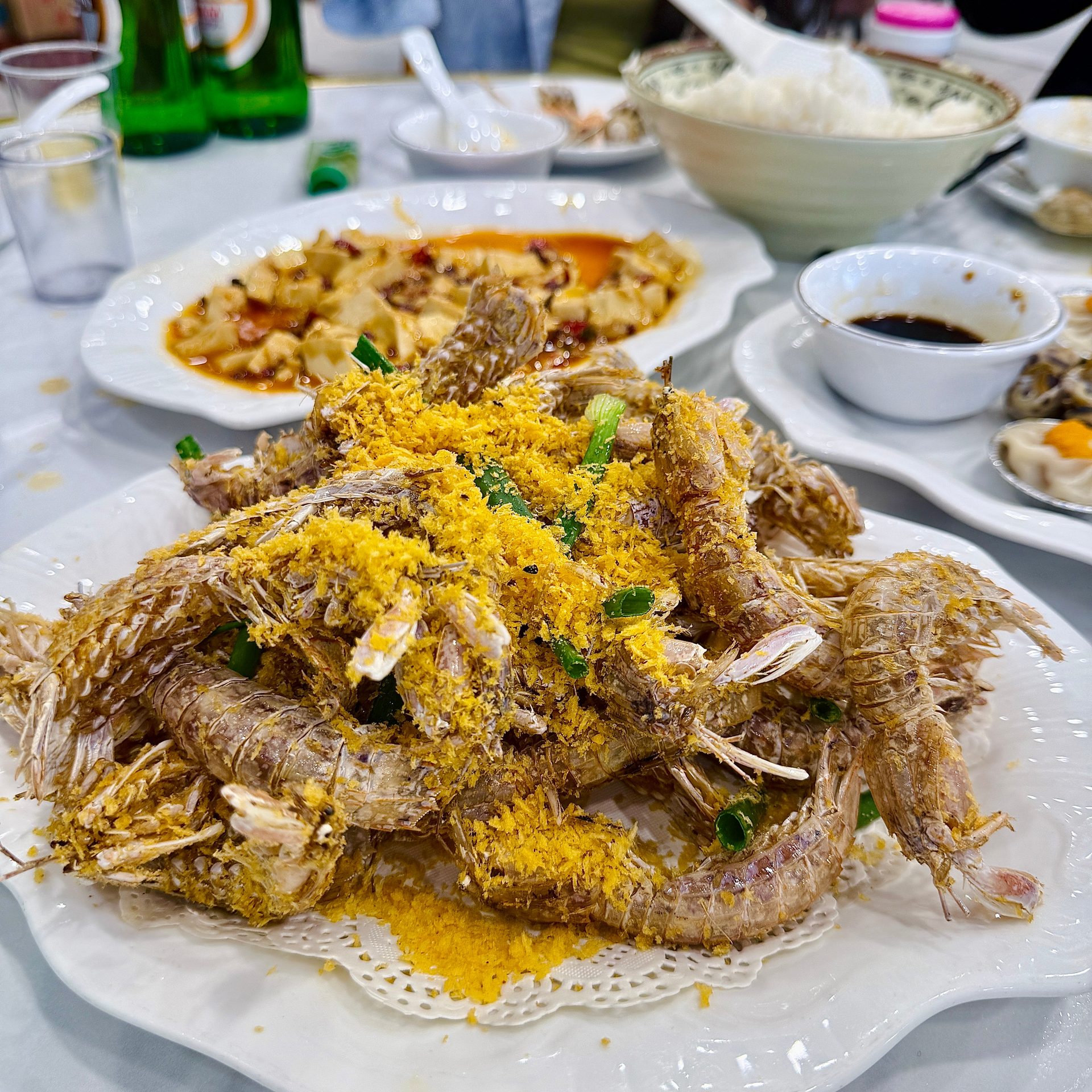
Steamed fish, razor clams with garlic, mantis shrimp fried with salt and pepper, crab with glass noodles, and a rice porridge cooked with crab or prawns in a clay pot. Seafood restaurants display everything live and price it by weight. Ask the price per jin, 500 grams, before you choose, and have the weight confirmed.
Sweets and fruit
Maci are soft rice-flour balls rolled in ground peanut and sesame. Manjiangao is a thick pancake folded over peanut sugar. Siguotang is a bowl of shaved ice with beans, jelly and fruit. Fruit stalls sell mango, wax apple and guava ready cut.
Temple vegetarian food
Nanputuo Temple runs the best-known vegetarian kitchen in the city, and its noodle hall is an easy lunch. Details are in our Nanputuo guide.
At a glance
| Dish | Spicy? | Contains | When |
|---|---|---|---|
| Shacha noodles | Mild | Peanut, shellfish, often pork | Any time |
| Oyster omelette | No; sauce on side | Shellfish, egg | Lunch, evening |
| Popiah | No | Wheat, pork, shellfish, peanut | Lunch |
| Peanut soup | No | Peanut | Breakfast, snack |
| Tusundong | Mustard on top | Marine worm, soy | Snack |
| Ginger duck | No | Duck, sesame | Dinner |
| Meat zongzi | No; sauce on side | Pork, shrimp, peanut sauce | Any time |
| Mianxianhu | Peppery | Wheat, varies | Breakfast |
Where to eat
We do not name individual restaurants here, because they change and because the best one is usually the busy one nearest you. Neighbourhoods are more reliable.
- The Eighth Market and the lanes north of Zhongshan Road. The densest concentration of old snack shops. Best at breakfast. See our old town walk.
- Around Xiamen University and Shapowei. Student prices, shacha noodle shops, cafes.
- Zengcuo'an. Street food in quantity, aimed at visitors. Fun in the evening.
- Shigu Road, Jimei. Cheap, local, good noodles.
- Longtou Road, Gulangyu. Convenient, pricier, and fine for a snack lunch.
A rule that works everywhere in the city: a queue of locals at eight in the morning is a better guide than any list.
Ordering without Chinese
Most small places have picture menus on the wall, or the food is in front of you. Pointing is normal. A translation app with a camera mode reads menus well enough. For the noodle counters, point at the toppings you want and hold up fingers.
Useful phrases, written to show:
- 不要辣 (bú yào là): no chilli
- 我对花生过敏 (wǒ duì huāshēng guòmǐn): I am allergic to peanuts
- 我对海鲜过敏 (wǒ duì hǎixiān guòmǐn): I am allergic to seafood
- 我吃素,不要肉、不要猪油、不要虾 (wǒ chī sù): I am vegetarian; no meat, no lard, no shrimp
- 多少钱一斤?(duōshao qián yì jīn): how much per 500 g?
A few cautions
Tap water is not for drinking. Stick to bottled water and hot tea.
One family wrote that their child fell ill after an afternoon of grazing on a dozen different snacks in the heat on Gulangyu. Pace yourself, especially with fried food and shellfish in summer.
Peanut and shellfish are close to unavoidable in the local snack repertoire. If either allergy is severe, eat in restaurants where you can speak to the kitchen, or let a guide do it for you.
Quick answers
What food is Xiamen famous for?
Shacha noodles, oyster omelette, fresh spring rolls (popiah), peanut soup, tusundong sea-worm jelly, ginger duck and seafood of every kind.
Is Xiamen food spicy?
No. Southern Fujian cooking is light and slightly sweet. Chilli usually comes as a sauce on the side. Shacha broth has a mild warmth.
Is Xiamen good for vegetarians?
It takes care. Many snacks that look vegetarian are cooked with lard, dried shrimp or oyster. The vegetarian restaurant at Nanputuo Temple is the reliable choice.
Can I find halal food in Xiamen?
There are a small number of halal restaurants and Lanzhou-style noodle shops. Local Minnan snacks generally contain pork or lard and are not halal.
Is street food in Xiamen safe?
Busy stalls with high turnover are generally fine. Do not drink tap water, go easy on raw shellfish, and do not eat ten different snacks in one hot afternoon.
What should I do if I have a peanut or shellfish allergy?
Take it seriously here. Peanut is the base of shacha sauce and appears in soups, sweets and garnishes, and shellfish is in broths and fillings where you would not expect it. Carry your allergy written in Chinese.
Keep planning
Sources we checked
Last checked: October 2026. Tickets, ferries, opening hours and entry rules change; we confirm the current arrangement for your dates before you travel.
Eat Xiamen with someone who knows where
Tell us what you like and what you cannot eat. We can build the meals into a private route and do the ordering for you.